
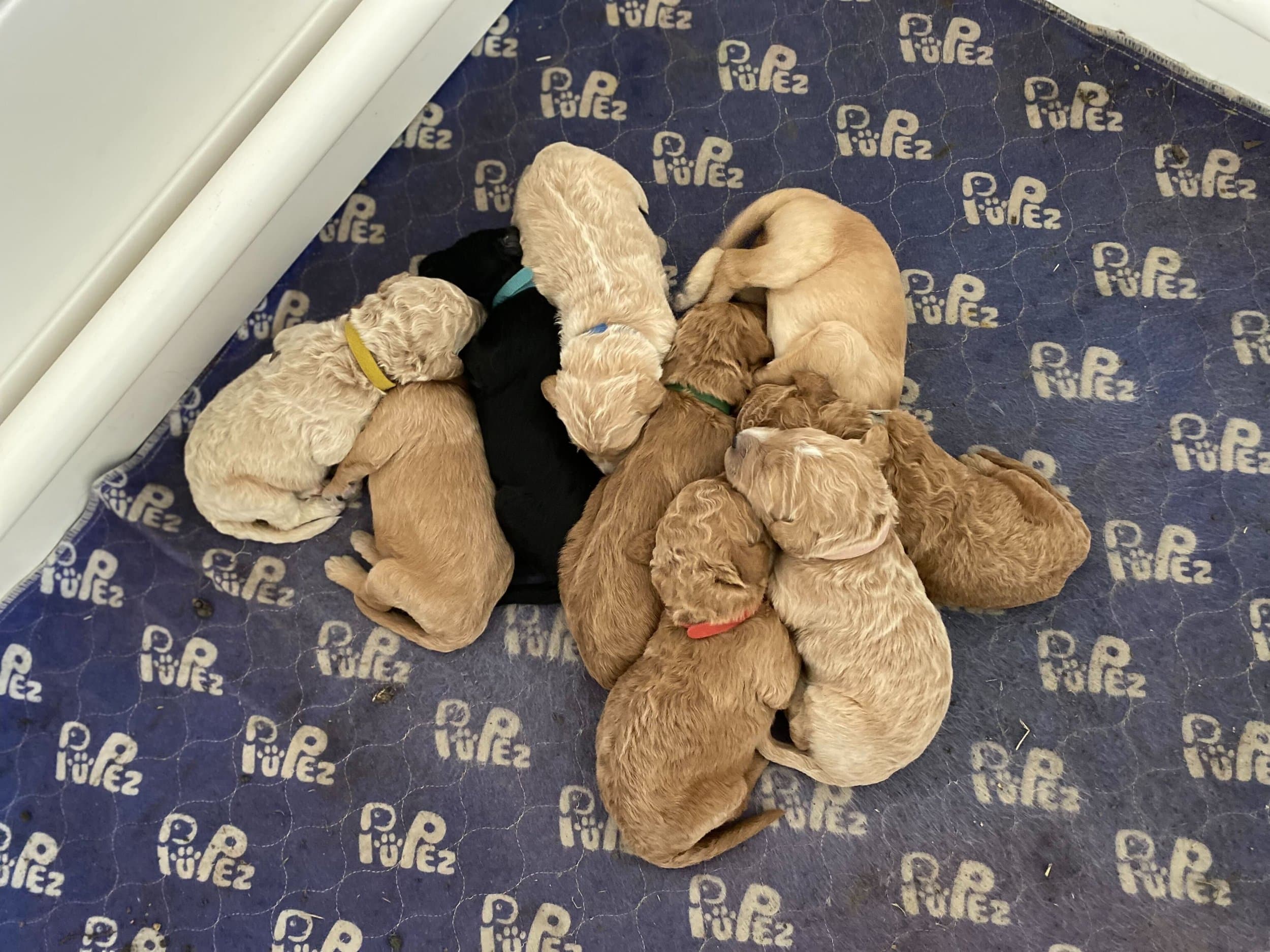
Health testing decides how sound a puppy's body is. Socialization decides who the puppy becomes. By the time one of our Goldendoodles goes home at 8 weeks, it has already lived through the single most formative stretch of its life — and how a breeder spends those weeks is largely what separates a confident family dog from a nervous one.
Here's what actually happens in our homes between birth and pickup day, week by week, across all three of our families — the Purkeys, the Stinnetts, and the Gentrys.
The First Eight Weeks, Week by Week
Weeks 1–2: daily handling before their eyes open
Newborn puppies can't see or hear yet, but they feel everything. Every puppy in the litter gets picked up, weighed, and gently handled every single day from day one — held in different positions, touched on the paws and ears and belly, and set back with mom. It sounds small. It isn't. Puppies handled briefly and often in these first two weeks grow into dogs that don't panic at a vet exam or a nail trim.
We're also watching mom closely during this stretch. A calm, well-fed, unstressed mother raises calmer puppies, which is one more reason we care so much about the temperament of our parent dogs.
Weeks 3–4: the window opens
Around three weeks the eyes and ears are working, the puppies start wobbling around, and the critical socialization window opens. This is when we move the whelping area into the living space of the house. Our puppies are raised inside our homes — not in an outbuilding — so the dishwasher, the vacuum, the TV, the doorbell, and a house full of talking become ordinary background noise rather than a shock later on.
They also start meeting surfaces here: tile, hardwood, carpet, a towel, a low ramp. A puppy that has walked on five different footings before it's a month old rarely balks at a new one.
Weeks 5–6: people, kids, and playtime
By five weeks the puppies are fully mobile, weaning onto solid food, and genuinely playing with each other — which is how they learn bite inhibition and how to read another dog. We add people on purpose during these two weeks: men and women, our own children, grandparents, and visitors. Kids matter more than most people realize. They move fast, sound different, and pet differently than adults, and puppies who meet them early tend to stay relaxed in a busy household.
Litters also sort themselves out here. Watching them play is how we get a real read on which puppy is bold, which is the cuddler, and which is the quiet observer — and it's why we can usually point a family toward the right puppy in a litter of F1B Goldendoodles rather than leaving it to chance.
Weeks 7–8: crates, cars, and the vet
The last two weeks are about the specific things a puppy is going to face in its first week with you. An open crate goes into the puppy area with bedding and treats, so the crate is a familiar piece of furniture instead of a trap on night one. Puppies get short car rides. Each one gets its first puppy shot and a well-check with our vet, which doubles as practice at being handled by a stranger.
They also start spending short stretches away from their littermates. A puppy that has never once been alone will scream the first night in a new house. A little practice beforehand takes real pressure off the transition — the rest of it we cover in our guide to crate training a Goldendoodle puppy.
Why This Is the Part You Can't Buy Back
Everything else about a puppy can be addressed later. Training can start at any age, diet can be corrected, grooming is a habit you build. But the socialization window closes at around 12 weeks, and a puppy that spent weeks 3 through 8 in a barn with minimal human contact starts life several steps behind. That gap can be narrowed with a lot of patient work, but it is far easier to never create it.
That's the honest reason we're a small, family-run program. Three families, hands-on with every litter, every day — because this part doesn't scale. If you'd like to know how a specific litter is being raised, just ask us. You can also read more about our families or see who's available right now.
Frequently Asked Questions
When does puppy socialization actually start?
Socialization starts the day a puppy is born, not at 8 weeks. Even before their eyes open, puppies register touch, warmth, and scent, and gentle daily handling in those first two weeks builds a tolerance for being held that carries into adulthood.
What is the critical socialization window for puppies?
The critical socialization window runs from roughly 3 to 12 weeks of age. Experiences during this period shape a dog's lifelong reaction to people, noise, and new environments — which is why the breeder's work between weeks 3 and 8 matters so much, and why the weeks right after pickup matter just as much.
Are Purkey puppies raised in the house or in a kennel?
Our puppies are raised inside our homes, not in an outdoor kennel building. That means they grow up hearing dishwashers, doorbells, televisions, and family conversation as ordinary background noise instead of meeting all of it for the first time on pickup day.
Are the puppies around children before they go home?
Yes — our puppies are handled by children in all three of our families every week. Kids move quickly, sound different than adults, and pet differently, so early exposure is one of the best predictors of a dog that stays relaxed in a busy household.
Why do Goldendoodle puppies go home at 8 weeks?
Eight weeks is the point where a puppy is fully weaned and independent enough to bond hard with a new family while the socialization window is still wide open. Leaving too early costs the puppy critical lessons from its mother and littermates; leaving much later means the new family misses weeks they could have spent building the bond themselves.
Is my puppy already crate trained when it comes home?
No — your puppy will have seen and slept near a crate, but full crate training happens at your house. Our goal is that the crate is already a familiar object rather than a frightening one, which typically shortens the first week of training considerably.
Do I still need to socialize my puppy after pickup?
Yes, and the weeks right after pickup are the most important ones you control. The socialization window stays open until about 12 weeks, so keep introducing new people, surfaces, and sounds at a pace your puppy handles calmly — following your vet's guidance on where it's safe to go before vaccinations are complete.
Ready to Reserve Your Puppy?
Join the waitlist for an upcoming litter from our Midland or Dallas, TX program. Each puppy is $1,700 — a $200 reservation fee holds your spot, with $1,500 due at pickup.